
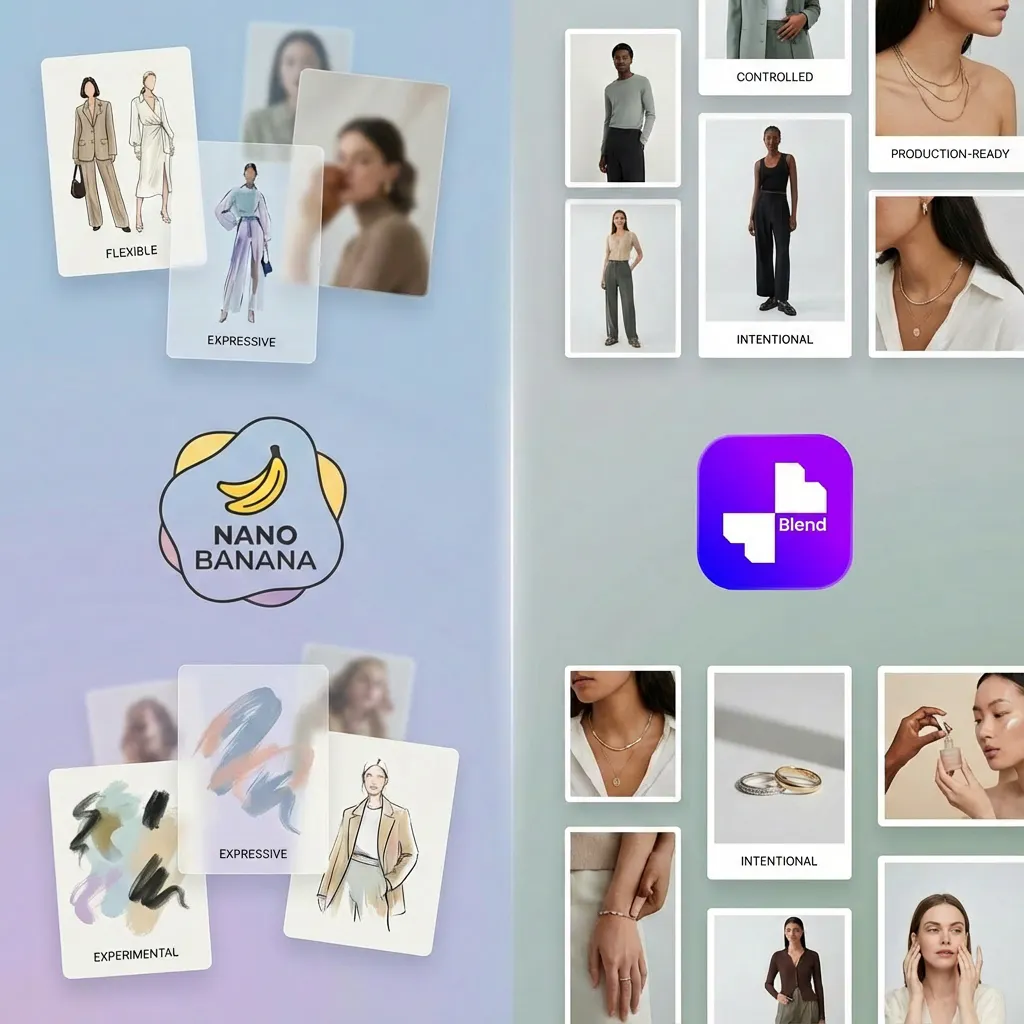
In today’s AI landscape, the number of tools available can feel overwhelming. From Nano Banana to Gemini, ChatGPT, Veo, and many others, the choices are endless. It’s natural to feel confused about which tool is actually right for you.
We don’t blame you for that confusion. Most AI tools are powerful in their own way, each designed with different strengths, assumptions, and priorities. Many of them perform exceptionally well in generic creative scenarios, especially when the goal is experimentation, ideation, or visual exploration.
And if you are an e-commerce brand, especially those selling on marketplaces like Etsy or running a D2C store, the real challenge is not whether AI works, but which kind of AI actually fits production workflows.
This article breaks down the difference between:
General AI tools like Nano Banana and Dedicated AI software like Blend,
with a clear focus on catalogue creation, consistency, and scale for your business.
TL;DR: The Core Difference
- Nano Banana is a flexible, general AI tool designed for experimentation and creative exploration.
- Blend is a dedicated AI platform explicitly designed for commerce-ready visuals at scale.
If your goal is ideation or one-off creatives, general AI tools work well.
If your goal is consistent catalogues, faster launches, and predictable output, dedicated AI software performs better.
What is Nano-Banana?
Nano-Banana refers to a class of general-purpose AI tools designed to generate visuals from prompts, experiment rapidly with styles, moods, and compositions, and explore creative directions quickly; they are powerful precisely because they are open-ended, prioritising flexibility and creative freedom over structured, production-focused workflows.
Where Nano Banana Works Well
Nano Banana works well for early-stage creative exploration, supporting rapid mood board development and concept testing, enabling experimental social media visuals, and appealing particularly to designers who enjoy prompt-driven iteration as part of an exploratory, low-friction creative workflow.
What Is Blend?
Blend is a dedicated AI software platform built specifically for visual commerce. Rather than starting from a blank prompt, Blend begins with a defined production outcome: clean product visuals, marketplace-compliant outputs, and repeatable styles across entire catalogues. It treats catalogue creation as a structured software workflow rather than a creative experiment, enabling businesses to produce consistent, scalable, and commerce-ready imagery.
Where Blend Works Well
Blend is well-suited for apparel, accessories, beauty, and lifestyle catalogues; e-commerce sellers operating on platforms such as Etsy and eBay; D2C brands that require consistent PDP visuals; and teams without access to in-house studios or professional photographers. It is optimised for speed, consistency, and scale, capabilities that are critical in the e-commerce environment.
General AI vs Dedicated AI: A Practical Comparison
1) Consistency
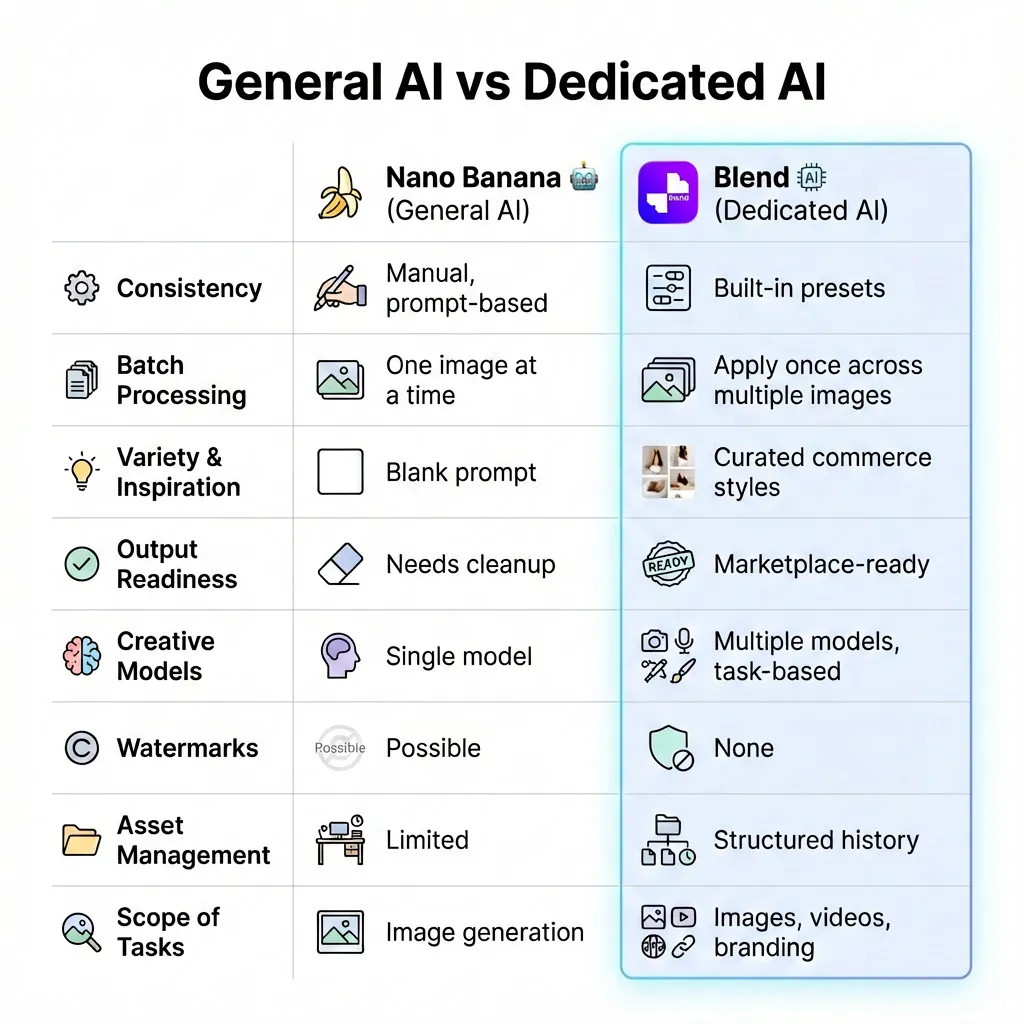
With Gemini or Nano-Banana, each image generation behaves independently. Maintaining consistency requires saving and reusing prompts, then adjusting them repeatedly to achieve a similar output. Even then, results tend to drift. Whereas with Blend, Consistency is built into the product. Presets and templates allow the same visual rules, lighting, framing, background, and style to be applied across the entire catalogue with minimal effort.
For example, with apparel, keeping the same background, crop, and pose across multiple SKUs is difficult with Nano Banana. Blend applies the same setup across all products. Similarly, take the case of jewellery, small lighting changes can affect the appearance of metal and stone. Blend maintains uniform material representation in this case.
2) Batch Processing
With Nano Banana, images are processed one at a time, meaning that if a user has 20 product images, the same steps must be applied to each asset individually. Blend, by contrast, supports batch processing, allowing users to upload multiple photos simultaneously and use the same settings across the entire set, ensuring uniform changes and significantly improving efficiency.
3) Variety and Inspiration
Nano Banana starts from a blank prompt, with output variety largely dependent on the user’s ability to imagine, articulate, and iteratively refine ideas through text. Blend, in contrast, provides structured inspiration by allowing users to select from predefined styles and formats grounded in real commerce use cases and established seller patterns.
For example, in apparel, proven lifestyle and studio formats are available without any prompting, while in jewellery, styles are intentionally constrained to realistic, commerce-safe visuals rather than experimental or abstract outputs.
4) Output Readiness and Resolution
With Nano Banana, generated images often require additional post-processing to meet marketplace standards for resolution, framing, and background cleanliness. Blend, by contrast, produces images that are commerce-ready from the outset, with higher resolution, correct framing, clean backgrounds, and consistent lighting.
For example, jewellery has fine details that are preserved in zoom-level PDP views without extra post-processing.
5) Single Creative Model vs Multi-Model System
Nano Banana operates as a single-model system, meaning every output—regardless of the task—is generated by the same model. Blend, in contrast, functions as a multi-model system at the backend, intelligently selecting and applying different AI models based on the user’s input and the specific task requirements.
6) Watermarks and Commercial Usability
With Nano Banana, users may encounter watermarks, creating uncertainty around whether images are suitable for direct commercial use. Blend, by contrast, produces watermark-free photos that can be used immediately across marketplaces, advertisements, and product pages without additional checks or rework.
7) Asset Management and Reusability
With Nano Banana, previously generated images are difficult to organise and retrieve, making it challenging to revisit or reuse past outputs. Blend, in contrast, functions as a structured asset system, allowing users to access prior results, reuse settings, and manage catalogue visuals systematically.
8) Beyond Image Generation: End-to-End Visual Tasks
Nano Banana primarily focuses on image generation; once an image is created, any additional work, such as changing backgrounds, creating variations, generating videos, or applying brand assets, typically requires starting a new generation or switching to another tool. Blend, by contrast, supports multiple commerce-focused tasks within a single system, enabling users to change backgrounds, generate product videos, apply logos, reuse brand elements, and manage visual assets across formats without leaving the platform.
When General AI Tools Make Sense
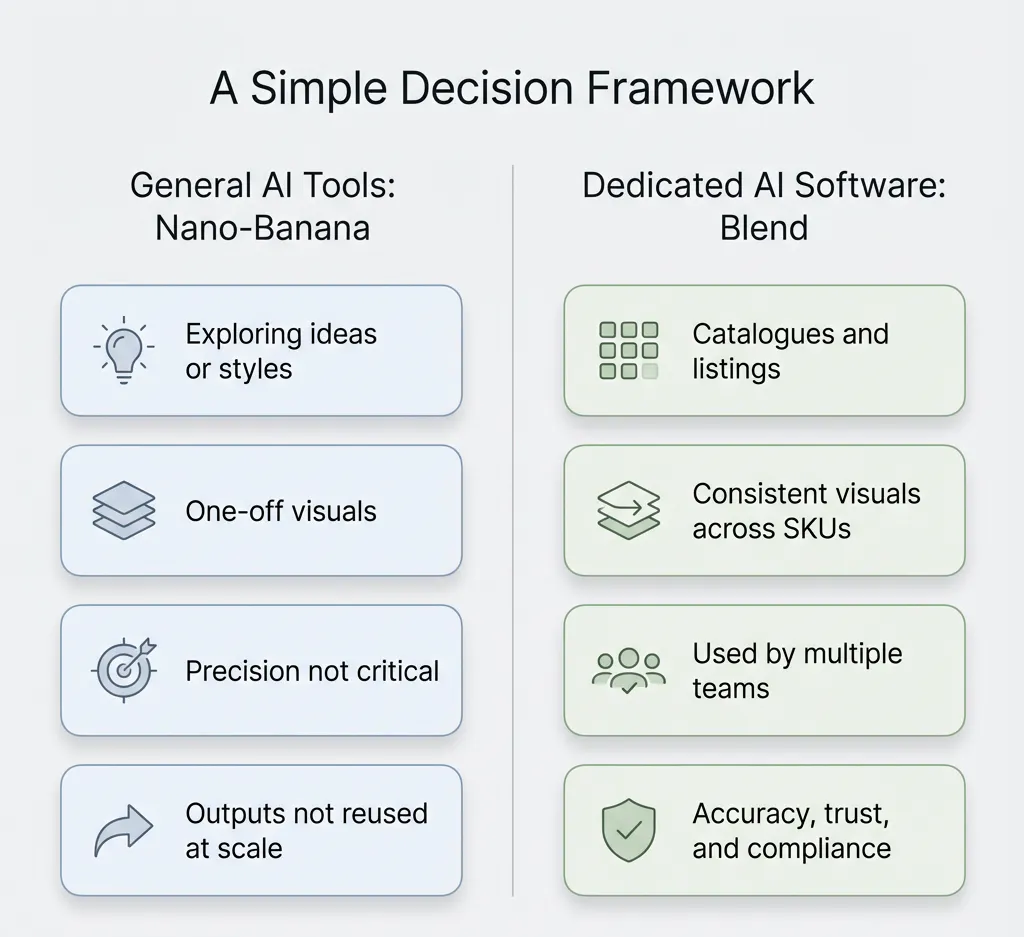
General AI tools like Nano Banana are a strong fit when:
- Visuals are exploratory
- Creative variation is the goal
- Volume is low
- Strict standards do not bind outputs
They excel in ideation and early-stage creative work.
When Dedicated AI Software Wins
Dedicated AI software like Blend becomes the better choice when:
- Catalogue size is large or growing
- Visual consistency is non-negotiable
- Speed to market matters
- Teams want predictable outcomes
This is especially true in visual commerce environments where trust, clarity, and uniformity matter more than novelty.
Final Takeaway
As AI tools become more accessible, the core challenge shifts from creating visuals to trusting them. Across apparel, jewellery, cosmetics, and accessories, a clear pattern emerges: when visuals represent real products, accuracy matters far more than novelty.
If your AI workflows feel unstable, inconsistent, or require too much manual effort, it’s often a sign that you’ve outgrown the experimentation phase.
Blend is built for teams that need AI to function as production infrastructure, dependable, repeatable, and aligned with the practical demands of visual commerce.