


You can spend weeks perfecting a product, months sourcing materials, and thousands on marketing. But if your product photos fail to make a strong first impression, most shoppers will never reach the checkout page. That's the reality of online selling.
Ecommerce product photography has become one of the most important parts of selling online because customers can see how your product is. Your product images need to build trust and help customers make buying decisions faster.
With the right photography techniques and modern AI-powered tools like Blend, you can create high-quality ecommerce product photos effortlessly. If you want to save your time and generate high-quality visuals for your brand, let's learn about ecommerce product photography, including photography styles and how to scale content creation without having to book expensive photoshoots.
What is Ecommerce Product Photography?
Ecommerce product photography is the process of creating images specifically designed to sell products online. Ecommerce photography is focused mainly on conversions. Every image should help answer questions that customers naturally have before making a purchase.
- What does the product look like?
- How large is it?
- What materials is it made from?
- How does it fit into everyday life?
- What details make it different from competing products?
From Shopify sellers to Amazon, Etsy, WooCommerce, and including your own website, product photography for ecommerce helps remove your buyers’ doubts and increase their confidence.
The best ecommerce product photos don't simply look attractive. They provide information that helps customers feel comfortable clicking the buy button.
Why Ecommerce Product Photography Matters for Online Sales
Online shoppers make decisions quickly. Research consistently shows that visuals play a major role in purchasing decisions. According to industry benchmarks, upgrading to professional, platform-compliant product images can increase conversion rates by 30% to 70% on some ecommerce platforms.
Better product imagery can also reduce return rates by up to 22% because customers have a clearer understanding of what they're buying. When your product images are high-quality, customers naturally assume your products are high-quality too.
That's why professional product photography delivers benefits beyond aesthetics. If you are competing against dozens of similar products, your photography product strategy often becomes the deciding factor.
Pro Tip: Before increasing your advertising budget, improve your product photos. Better visuals boost your sales online immensely.
Ecommerce Image Requirements by Platform
Different ecommerce platforms have different requirements for product imagery. Understanding these requirements helps ensure your listings remain compliant while delivering the best customer experience.
Platform | Main Image Requirement | Ideal Resolution | Best Secondary Images |
Pure white background (RGB 255,255,255), product should occupy at least 85% of frame | 2000px x 2000px | Lifestyle images, product videos, scale references, infographics | |
Shopify / D2C Stores | Flexible backgrounds allowed, including lifestyle and branded scenes | 2048px x 2048px | User-generated content, close-ups, 360-degree views |
Creative and styled backgrounds often perform well | Minimum 2000px wide | Detail shots, texture photos, lifestyle imagery |
Following platform-specific guidelines helps maximise visibility while ensuring your ecommerce product photos look professional across every channel.
Types of Ecommerce Product Photography Every Online Store Needs
Many brands rely on a single product image and assume that's enough. Modern shoppers expect much more. The most successful online stores use a combination of photography styles to answer different customer questions.
1. White background product photography
White background photography remains the foundation of ecommerce. A clean background removes distractions and keeps attention focused entirely on the product. It also meets the image requirements of marketplaces such as Amazon.
White background images work particularly well for electronics, beauty products, jewellery, home goods, and accessories.
2. Lifestyle product photography
Lifestyle photography shows products being used in real-world settings. Instead of displaying a candle on a plain background, you might show it on a coffee table in a cosy living room. Instead of photographing a kitchen gadget alone, you might show someone using it while preparing a meal.
Lifestyle photography helps customers imagine themselves using the product. That emotional connection often influences purchasing decisions more than technical specifications.
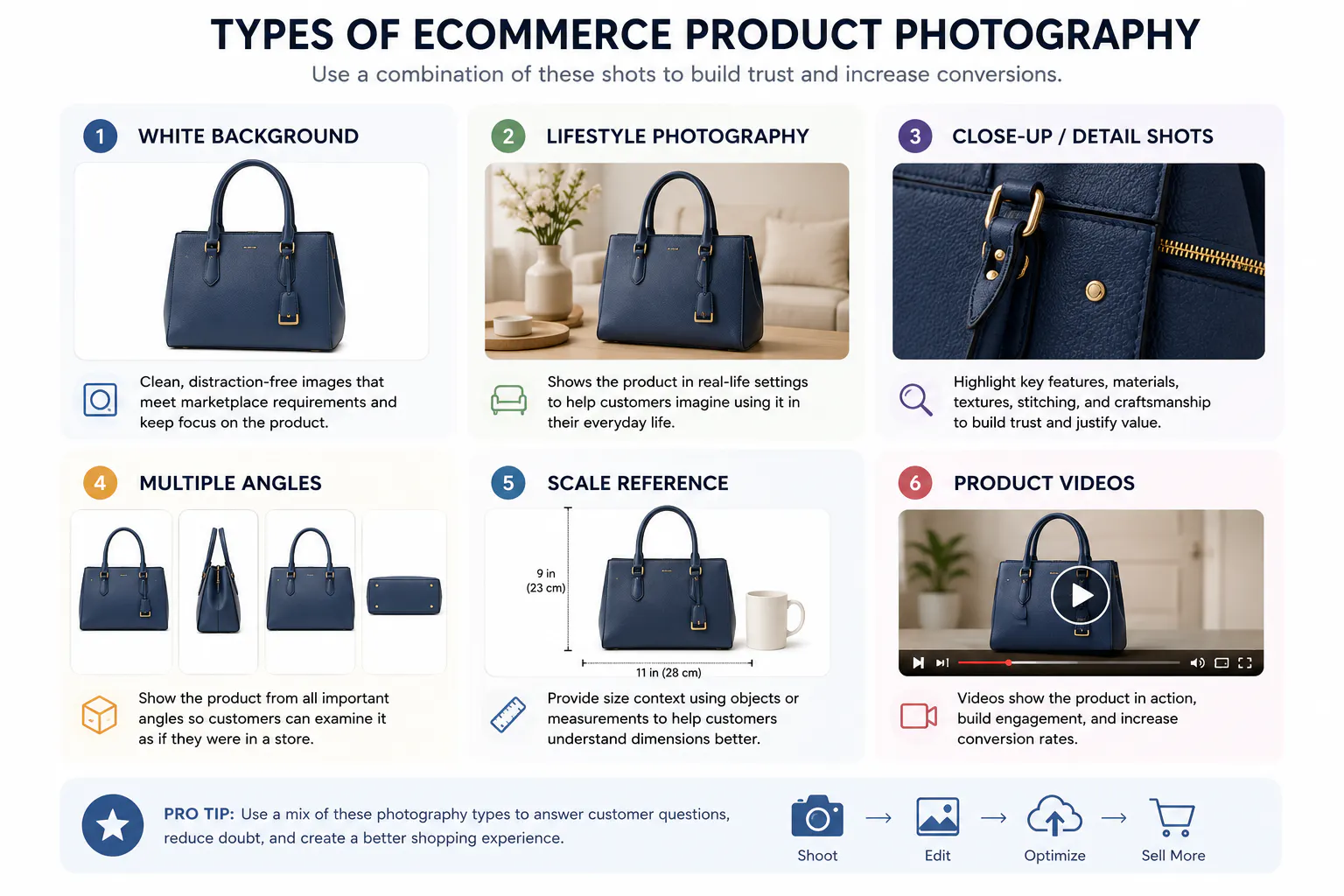
3. Close-up detail photography
Customers cannot physically inspect products online, so detail photography becomes extremely important. Close-up images allow shoppers to examine:
- Materials
- Textures
- Stitching
- Surface finishes
- Packaging details
- Product craftsmanship
These images help justify premium pricing and build confidence.
4. Multiple-angle photography
A single front-facing image rarely tells the whole story. Customers want to see products from multiple perspectives before making a purchase. Including front, side, back, top, and detail views helps replicate the in-store shopping experience.
5. Scale photography
Size confusion is one of the biggest causes of product returns. Showing products beside familiar objects or in a person's hands provides useful context and helps customers understand dimensions more accurately.
Are Coloured Backgrounds Common in Ecommerce Product Photography?
Yes, increasingly so. While white backgrounds remain essential for marketplaces and catalogue listings, coloured backgrounds have become popular across ecommerce marketing campaigns.
- Beauty brands often use pastel backgrounds to create a clean and modern look.
- Luxury brands frequently choose neutral tones such as beige, cream, or soft grey.
- Seasonal campaigns may incorporate festive colours to support promotions.
The most important product photography tip is simple: the background should support the product rather than compete with it. A background that distracts customers from the product ultimately hurts conversions.
What Background Colours are Used in Ecommerce Product Photography?
The best background colour depends on your product category, target audience, and brand identity. White remains the most widely used option because it feels clean, professional, and versatile. However, many brands successfully use:
- Light grey
- Beige
- Soft cream
- Pastel pink
- Light blue
- Muted green
- Brand colours
Consistency matters more than colour choice. When every image follows a similar visual style, your catalogue feels more professional and trustworthy.
Pro Tip for DIY Shooters: If you are using a smartphone for your product shoot, avoid digital zoom completely. Move physically closer to the product instead. Digital zoom reduces image quality and makes product details appear less sharp.
Ecommerce Product Photography Trends 2026
The ecommerce photography landscape is changing rapidly. Brands that embrace new trends early often gain a competitive advantage. One of the biggest ecommerce product photography trends 2026 is the rise of AI-generated content.
Businesses can now create realistic lifestyle scenes, promotional assets, and seasonal campaigns without building physical sets. Product videos are also becoming increasingly important. Shoppers want to see products in motion before making purchasing decisions.
Other trends shaping ecommerce photography include:
- AI-generated backgrounds
- Image-to-video content
- Mobile-first photography
- Interactive shopping experiences
- 360-degree product views
- Personalised visual merchandising
- User-generated content integration
These trends are helping brands create more engaging experiences while reducing production costs.
How to Scale Ecommerce Product Photography Without Hiring More Staff
As your product catalogue expands, content demands increase dramatically. A store with ten products may need a few dozen images. A store with five hundred products may need thousands. You will need content for:
- Product pages
- Marketplaces
- Social media
- Advertising campaigns
- Email marketing
- Seasonal promotions
Traditionally, scaling content production meant hiring more photographers, designers, and editors. Today, many brands are choosing a different approach. Instead of increasing headcount, they're using AI-powered product photography workflows to generate more assets from fewer source images.
A single product photo can become:
- A marketplace listing image
- A lifestyle scene
- A promotional banner
- A social media graphic
- A seasonal campaign visual
This dramatically improves efficiency while maintaining consistency.
How Blend Helps Ecommerce Brands Scale Product Photography
This is where many ecommerce businesses encounter a challenge. They understand the value of professional imagery but don't want to organise new photoshoots every time they launch a campaign. Imagine you are launching a summer promotion.
Traditionally, you would need a photographer, props, location, editing support, and a production budget. Then imagine repeating that process for autumn, Black Friday, Christmas, and spring campaigns.
The costs quickly add up. Instead, many D2C brands are using AI-powered platforms like Blend to extend the value of every product image they create.
For example, a merchant can upload a single well-lit smartphone photo and instantly generate multiple versions of the same product.
That single image can become:
- A white-background marketplace listing
- A pastel-coloured beauty advertisement
- A luxury ecommerce banner
- A lifestyle kitchen scene
- A social media promotional graphic
All without organising additional shoots. Rather than replacing photography, Blend helps businesses get more value from every image they already have.
How to Create Ecommerce Product Photography Using Blend
Creating professional ecommerce visuals with Blend is straightforward. Here’s how to do it with Blend:
- Start by uploading a high-quality product image.
- Go to Studio Shot feature. It will automatically give your product in a plain white background under a few seconds
- From there, you can create different image variations based on your goals.
Need an Amazon-ready white background image? Create it instantly. Need a branded lifestyle scene for Instagram? Generate it from the same source image using Lifestyle Shot feature.
Want seasonal campaign assets? Create multiple versions without arranging additional photoshoots. Once complete, export your images for Shopify, Amazon, Etsy, social media, advertising campaigns, and email marketing.
Pro Tip: Always capture product photos at the highest available resolution. High-resolution files provide greater flexibility for cropping, zoom functionality, and future editing.
Common Ecommerce Photography Mistakes That Reduce Conversions
Even high-quality products can struggle when photography is inconsistent. Common mistakes include:
- Poor lighting
- Low-resolution images
- Too few product photos
- Inconsistent backgrounds
- Over-editing
- Inaccurate colours
- Missing scale references
- Slow-loading image files
Remember, your goal is not to make products look different. Your goal is to make them look their best while accurately representing what customers will receive. Trust is difficult to earn and easy to lose.
Conclusion
Ecommerce product photography is one of the most valuable investments you can make in your online store. Strong visuals build trust, increase conversions, reduce returns, and help products stand out in crowded marketplaces.
If you rely on professional product photography services, a DIY setup, or a hybrid workflow, the goal remains the same: help customers understand exactly what they're buying. As AI-powered tools like Blend continue to evolve, creating professional ecommerce product photos is becoming faster, easier, and more scalable than ever before.